
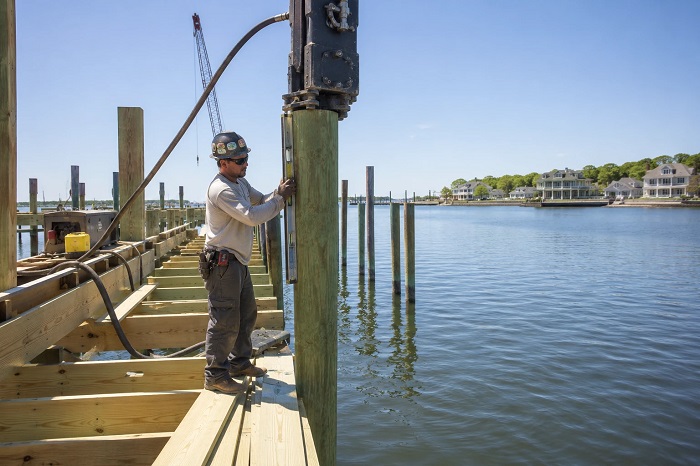
A waterfront structure may look finished when the deck, wall, or walkway is complete, but its long-term performance depends on the support below. Proper pile driving helps docks, piers, boardwalks, bulkheads, boat lifts, and shoreline structures remain stable under load, water exposure, and changing site conditions.
Property owners who want stronger marine foundations can explore this installation service before building, replacing, or repairing structures near the water.
Pile driving must be accurate because small errors can affect the entire structure above. If piles are not vertical, not deep enough, poorly spaced, or wrong for the soil, the framing may become difficult to install and the finished structure may not perform as expected.
Professional equipment and site planning help reduce those risks. Hydraulic hammers, vibro-drivers, and drilling rigs are used depending on soil and access. The installation method should be selected after reviewing the bottom conditions, load requirements, and structure type.
What proper pile driving means
Proper pile driving means installing each pile to the correct depth, alignment, and spacing so it can support the structure above. It also means choosing a pile type that matches the soil, water depth, load, and environmental exposure.
Accuracy matters because piles become the reference points for the rest of the project. If they are out of line, the beams and decking may require awkward adjustments. If they are too shallow, the structure may settle. If they are wrong for the load, they may move under pressure.
Good pile driving also considers how the structure will be used after construction. A residential dock, commercial marina, heavy boat lift, and shoreline reinforcement system all place different demands on the foundation.
- Correct depth – piles must reach a suitable bearing layer so they can carry the required load.
- Vertical alignment – straight installation helps the structure above remain easier to frame, connect, and maintain.
- Proper spacing – pile layout should match beams, joists, walls, lifts, slips, and walking surfaces.
- Material fit – wood, steel, helical, and concrete supports should be chosen for the site and structure.
How poor pile installation creates problems
Weak pile installation can cause movement that appears later in the visible structure. A dock may feel uneven. A pier may begin to lean. A boardwalk may settle in soft areas. A bulkhead may lose alignment if the support system cannot resist pressure.
Many problems become more noticeable after storms, high water, or repeated use. Water movement and soil changes can expose weak installation. What looked acceptable immediately after construction may become unstable once the structure is under real conditions.
Repairs can be difficult because piles are below the structure and often below the waterline. Correcting a foundation problem after the upper structure is complete may require removal, reinforcement, or partial reconstruction. That is why proper installation at the beginning is so important.
Matching pile driving to soil conditions
Soil conditions control how piles are installed and how deep they need to go. Sandy and silty soils may be easier to drive. Clay can require more effort. Bedrock may require pre-drilling with specialized equipment.
Weak soils require deeper pile penetration to reach dependable support. Dense soils may allow shorter piles if the bearing capacity is suitable. The installation plan should be based on the actual bottom conditions, not a standard depth used for every project.
Soil also affects equipment selection. Hydraulic hammers, vibro-drivers, and drilling rigs all serve different purposes. Choosing the right method can improve efficiency and help the pile reach the required depth without unnecessary damage.
- Survey the bottom – understanding soil and water depth helps determine pile length and installation method.
- Calculate the load – the structure type, vessel weight, foot traffic, and marine equipment affect support needs.
- Select the pile type – wood, steel H-piles, helical piles, and concrete supports each fit different conditions.
- Install with accuracy – vertical placement and spacing help avoid framing problems and uneven load transfer.
- Inspect the final support – the pile layout should be checked before upper construction continues.
Why equipment choice matters
Pile driving equipment should be matched to the soil and access conditions. Hydraulic hammers can be efficient for standard driving conditions. Vibro-drivers may be useful in dense soils. Drilling rigs may be necessary when bedrock or difficult subsurface conditions are present.
Access also influences equipment selection. If crews can work from shore, the plan may be different than a project requiring barges or pontoons. Deep water, limited yard access, steep slopes, and existing waterfront structures can all affect the work plan.
Using the wrong equipment can increase time and reduce installation quality. The goal is not only to place the pile but to place it correctly, safely, and to the depth required for dependable support.
For projects with many piles, equipment mobilization and sequencing should be planned carefully. Efficient pile installation can support a smoother construction schedule for the rest of the project.
Long-term value for waterfront owners
Proper pile driving helps protect the investment made in the finished structure. A dock, pier, boardwalk, bulkhead, or marina can only perform as well as the foundation below it. Strong piles reduce the risk of settlement, movement, and early structural repairs.
For homeowners, this can mean safer access to the water, a more stable dock, and fewer disruptions. For commercial waterfront owners, it can mean better support for marinas, boat lifts, and structures that receive repeated use.
Good pile installation also supports future improvements. If the owner later adds a lift, expands a dock, or connects a walkway, the existing pile system can affect what is possible. Planning support correctly from the start can make future waterfront work easier.
A reliable waterfront structure begins before the deck boards, wall panels, or marina features are installed. It begins with piles that are selected, placed, and driven for the actual site conditions. When that foundation is right, the entire structure has a stronger chance of lasting longer and performing better.