
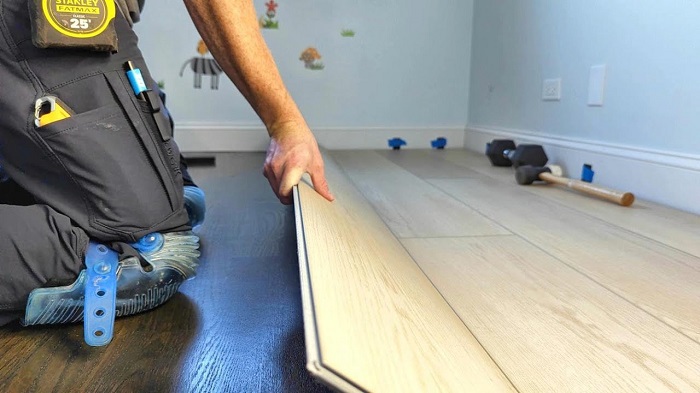
Premium flooring is valued for its stable geometry, distinctive texture, and long service life, but these qualities require impeccable preparation and precise adherence to technology. A mistake at any one stage—from adhesive selection to humidity control—can ruin the appearance and shorten the lifespan of even the most expensive material.
A professional approach begins with assessing the substrate, microclimate, and logistics: the material needs time to acclimatize, and the subfloor needs time to harden and dry. This workflow is especially important in luxury home renovation Calgary, where the requirements for the final result are extremely stringent.
Key Rules Before Installation
1) Subfloor: Evenness, Strength, and Humidity
Evenness is the key factor in achieving a premium visual effect: joints look neat, without sagging or creaking. Acceptable values depend on the type of flooring, but the benchmark is minimal variations along the course and the absence of localized “potholes.”
The strength of the base is checked for crumbling and peeling. Weak layers are removed, cracks are expanded and repaired, and dust is removed with an industrial vacuum cleaner. The moisture content of the screed and wooden bases is monitored using a device; “eyeballing” is unacceptable in the premium segment.
2) Microclimate and Acclimatization of Materials
The temperature and humidity in the room must be stable not only on the day of installation but also during the curing period of the adhesives/mixtures. The material is stored in its packaging in the installation room, adhering to the manufacturer’s recommended acclimatization time to avoid deformation and seam separation after installation.
3) Layout Planning and Expansion Gaps
Premium installation requires pre-calculated geometry: pattern direction, row offsets, placement of undercuts in inconspicuous areas, and symmetry relative to the room’s axes. Expansion gaps around the perimeter and at obstacles are essential for most flooring; they are concealed with baseboards or profile solutions without compromising the technology.
Criteria for Selecting a Luxury Flooring for a Room’s Conditions
A luxury flooring only reveals its full potential when it is appropriate for its operating conditions: humidity, traffic, temperature fluctuations, subfloor type, and maintenance requirements. A poor selection process leads not to cosmetic defects, but to accelerated wear, deformation, and loss of appearance.
When selecting, it’s important to evaluate not only the type of flooring, brand, and design, but also compatibility with the subfloor preparation, underfloor heating system, acoustic requirements, and available maintenance schedule. Below are practical criteria to help you choose a premium flooring for a specific space.
Key Selection Parameters
- Humidity and Water Risk: For kitchens, hallways, and areas prone to periodic spills, choose flooring with increased stability and moisture-resistant joining systems; For bathrooms and showers – specialized solutions designed for constant moisture.
- Traffic and abrasion resistance: In hallways and public spaces, a wear-resistant top layer, repairability, and resistance to sand/dirt are important (protection of the entrance area is mandatory).
- Dimensional stability: In areas with large temperature fluctuations and dry air, designs with high dimensional stability are preferable; for natural wood, microclimate control is critical.
- Compatibility with underfloor heating: Consider the permissible surface temperature, thermal resistance requirements, adhesive/underlay type, and the manufacturer’s recommendations for the heating system.
- Substrate type and installation method: Floating installation requires a perfectly level base and the correct underlay. Adhesive flooring – high-quality screed, suitable primers, and adherence to maintenance intervals.
- Acoustics: Impact noise and footfall sound are important for apartments and flats – choose solutions with a well-designed underlayment/sub-layer and proper adhesion to the walls.
- Maintenance and chemical resistance: If frequent wet cleaning is planned, consider resistance to household chemicals, pH requirements of the cleaning products, and the need to renew protective compounds.
- Repairability: Check the possibility of localized replacement of planks/tiles, sanding (for solid wood/engineered boards), and the availability of material from the same batch.
- Light and visual risks: In rooms with panoramic windows, consider resistance to fading, the visibility of scratches on dark/glossy textures, and the direction of installation relative to light.
- Describe the installation mode Operation: humidity, traffic, presence of animals, wheel loads, risk of spills.
- Check the manufacturer’s restrictions: underfloor heating, permissible substrate moisture, type of adhesive/underlayment, microclimate requirements.
- Agree on the installation technology: floating or adhesive, layout pattern, expansion gaps, thresholds/joints with other coverings.
- Create a maintenance plan: products, frequency, protection in walking area, scratch prevention.
Bottom line: the criteria for choosing a luxury flooring are not “the most expensive,” but rather the one most suitable for specific room conditions and the chosen installation technology. The more accurately you match humidity, load, microclimate, substrate, and maintenance with the manufacturer’s recommendations, the longer the flooring will maintain its geometry, appearance, and premium status.