
Most home improvement planning focuses on the parts of a house people can see — a new kitchen, a loft conversion, a fresh coat of paint on the exterior. The boiler, tucked away in a cupboard or utility room, rarely gets the same attention until the day it stops working. That’s a costly habit: by
the time most homeowners think seriously about replacing a boiler, they’re often paying far more than they would have if they’d acted a year or two earlier — in emergency callout fees, in wasted energy, and in the kind of mid-breakdown panic that leads to rushed decisions. Getting ahead of it
starts with knowing what to look for — and, for homes in Chelsea and across Central London, with booking a Gas Safe registered engineer for emergency boiler repair, a boiler service or a gas safety inspection. The same-day and 24/7 call-out details are set out at
https://oliasplumbingandheating.co.uk/mag/boiler-repair-chelsea/, so a small fault never has to become a full breakdown.
The Problem: Boilers Are Judged by Whether They Work, Not How Well
A boiler either heats the house or it doesn’t — and for most homeowners, that binary is the only test that matters. As long as the radiators get warm and the hot water comes out hot, the boiler is doing its job, and there’s little reason to think about it further. The trouble is that a boiler’s
performance degrades long before it fails outright, and that slow decline is almost invisible day to day.
An ageing boiler loses efficiency gradually: a heat exchanger accumulates scale, a pump starts working harder than it should, a thermostat drifts out of calibration. None of this trips an alarm. The radiators still get warm; the shower still runs hot. What changes is how much gas it takes to get
there, and how reliably the system holds up under real winter demand. By the time a fault is visible or audible — a banging noise, a pilot light that won’t stay lit, a radiator that never quite gets properly warm — the underlying wear has usually been building for a long time.
Most manufacturers design boilers for roughly 10 to 15 years of reliable service, and efficiency often starts dropping well before that window closes. A boiler nearing the end of its realistic lifespan can easily be running 15 to 20% less efficiently than when it was new, which shows up as a
higher gas bill every single month — a cost that’s easy to miss because it arrives gradually, mixed in with normal seasonal variation, rather than as one clear signal that something needs attention.
Where the Real Cost Builds Up
The financial case for timely boiler attention rests on a few compounding factors that are each individually easy to dismiss, but add up significantly over a few years:
- Efficiency loss is a hidden monthly tax. A boiler running below its rated efficiency burns more gas for the same heat output, every single day it’s in use — not just in winter. Over a full heating season, that difference is rarely trivial.
- Emergency repairs cost more than planned ones. A breakdown in January, when every other boiler in the area is also failing and engineers are stretched thin, typically costs more and takes longer to resolve than the same repair scheduled in a quieter month.
- Repeated small repairs can exceed the cost of replacement. It’s common for homeowners to spend on a sequence of small fixes — a new pump here, a new valve there — that collectively cost more than simply replacing an ageing unit with a modern, more efficient one would have.
- A failing boiler can damage other things. A leaking seal or a corroding pipe doesn’t always stay contained; water damage to flooring, cabinetry or a ceiling below can turn a plumbing problem into a much larger repair bill.
- Resale and EPC implications. For anyone planning to sell in the next few years, an old, inefficient boiler is something buyers and surveyors notice, and it can measurably affect a property’s Energy Performance Certificate rating.
What a Thorough Inspection Actually Looks For

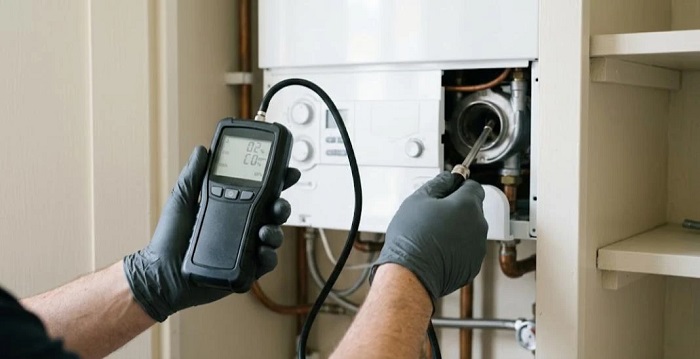
This is where the distinction between “the boiler works” and “the boiler is in good condition” becomes important, and where the quality of inspection genuinely matters. A proper annual service isn’t just a quick visual check and a pass certificate — it should include a combustion
analysis to check the burn is clean and efficient, a check of the heat exchanger and flue for signs of corrosion or blockage, an inspection of the pressure vessel and expansion tank, and a test of all the safety controls that are there specifically to prevent carbon monoxide escaping into the
home.
Gas Safe registration is the legal baseline for this work, not an optional extra. Only an engineer listed on the Gas Safe Register is legally permitted to work on domestic gas appliances in the UK, and that registration should extend specifically to the type of appliance being
serviced. Anything less exposes a homeowner to real safety risk — carbon monoxide poisoning from a poorly maintained flue or heat exchanger is a genuine danger, not a theoretical one, and it’s exactly the kind of fault a proper inspection is designed to catch early.
Boiler age alone isn’t always the right signal to act on. A well-maintained 12-year-old boiler can sometimes still be more sensible to keep running than a poorly maintained 8-year-old one. What actually matters is the condition it’s in now, which is precisely what a genuine
inspection — rather than a cursory annual tick-box visit — is meant to establish.
Why Chelsea and Central London Homes Feel the Delay More
The cost of putting off a boiler decision is not the same everywhere, and homes in Chelsea, Kensington and the wider Central and West London area tend to feel it sooner. Many properties here are period conversions or flats with compact combination boilers, tightly packed pipework and limited
cupboard access, which makes an ageing sealed system harder to diagnose and slower to repair when it fails. Pressure loss, ignition lockouts, kettling caused by limescale on the heat exchanger and slow leaks are the faults that show up most often on older units, and each one is cheaper to deal
with as a planned boiler repair than as a winter emergency.
That is why local availability matters as much as the repair itself. A Gas Safe registered engineer who can offer a same-day boiler repair in Chelsea, run a proper boiler service and carry out a gas safety inspection on the same visit will usually spot an ageing boiler’s warning signs before they
turn into a breakdown. For landlords letting property in the area, the annual landlord gas safety certificate (CP12) is also the natural moment to ask an honest question: repair, or replace? An engineer who also handles boiler installation can price both options side by side, so the decision rests
on the real numbers rather than on whichever bill arrives first.
The Fix: Build a Habit Around the Boiler, Not Just a Reaction to It
None of this requires a dramatic change in approach — it requires treating the boiler as part of the home’s regular maintenance rhythm rather than something to think about only in a crisis:
- Book an annual service before the heating season starts, not during the first cold snap when demand for engineers spikes.
- Ask for a genuine condition report alongside the standard safety certificate — not just a pass or fail, but a clear picture of where the system stands.
- Track repair costs over time. If the running total on small fixes starts approaching what a new unit would cost, that’s the signal to seriously consider replacement.
- Factor boiler efficiency into any wider home improvement or energy-efficiency plan — insulation and glazing upgrades achieve less of their potential if the heating system behind them is inefficient.
- Use a Gas Safe registered engineer who explains what they find, rather than one who simply completes the paperwork and leaves.
For homeowners across Central and West London working through exactly this kind of decision, Olia’s Plumbing & Heating is built around this more thorough approach. As a Gas Safe registered team, they carry out genuine boiler servicing and condition assessments — not a rushed
pass-and-file visit — along with installations when a system has genuinely reached the end of its useful life, so homeowners get an honest picture of where their system stands rather than a guess.
If a boiler hasn’t been properly serviced in the last year, or has started showing any of the small warning signs — inconsistent heat, rising bills, unusual noises — the sensible moment to act is before the next cold snap, not during it.
The Bottom Line
A boiler that still technically works isn’t the same as a boiler that’s running well, and the gap between those two states is where most of the avoidable cost in home heating quietly accumulates. Homeowners who treat the annual service as genuine maintenance, rather than a formality, catch the
small issues while they’re still small — and avoid the emergency breakdowns, inflated repair bills and creeping energy costs that come from a system that’s never properly looked after.
For anyone in Central or West London whose boiler is approaching the end of its expected lifespan, or simply hasn’t had a proper inspection in a while, that’s a conversation worth having with Olia’s Plumbing & Heating before winter makes the decision for you.