
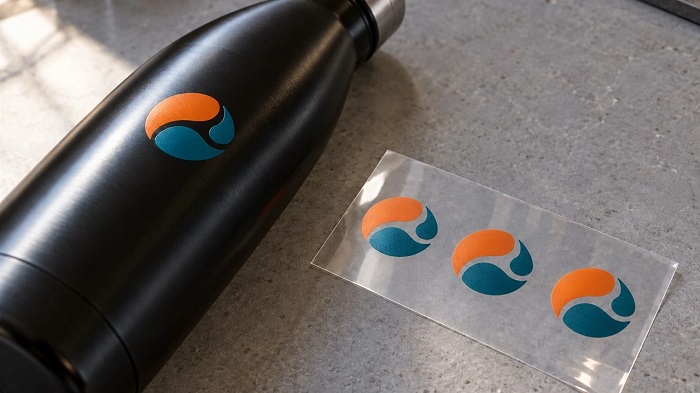
When promotional product decorators and commercial print shops use roll-to-roll UV DTF (ultraviolet direct-to-film) crystal transfers to brand stainless-steel insulated tumblers, water bottles, and travel mugs, long-term decal durability depends on matching adhesive contact pressure to the texture depth of the powder coat and setting honest hand-wash care expectations with the end buyer.
While a roll-to-roll UV DTF transfer applies effortlessly across tapered cup walls that frustrate cylindrical rotary UV printers, print shops must evaluate coating roughness, tapered geometry distortion, and thermal wash limits before quoting drinkware orders.
Why Tapered Drinkware Profiles Favor Roll-to-Roll UV DTF Over Rotary Direct Printing
Insulated stainless-steel drinkware rarely comes in a true straight-walled cylinder. Most travel tumblers feature a wider upper rim that tapers toward a narrow cup-holder base, often interrupted by a raised metal lip or handle. On a direct-to-object cylindrical UV printer, a steep cone angle forces the operator either to tilt the rotary chuck aggressively or risk out-of-focus ink mist at the narrow bottom end of the cup.
Roll-to-roll UV DTF transfers eliminate rotary chuck alignment completely:
- Constant droplet sharpness from top rim to base: Because the graphic is printed flat onto A-film and laminated to B-film at a uniform printhead gap, fine text near the bottom of a tapered mug stays just as sharp as the upper crest.
- No mechanical interference from handles or bottom steps: Operators can position and burnish a flexible B-film transfer within millimetres of a welded mug handle where a rotary printhead carriage would collide.
- Fast gang-sheet batching across mixed cup sizes: A single 60 cm roll can combine tall wraps for 40 oz tumblers alongside compact crests for 12 oz coffee mugs without stopping the machine to swap rotary rollers.
Powder-Coat Texture and Finish Compatibility Matrix for Drinkware Transfers
Not all powder-coated stainless steel behaves identically under pressure-sensitive UV DTF adhesive. Production managers should classify customer tumbler blanks across four common exterior finishes before committing to a bulk run.
| Drinkware Exterior Finish | Surface Contact Profile | UV DTF Adhesion Performance | Required Shop-Floor Protocol |
|---|---|---|---|
| Smooth gloss or satin painted stainless steel | Non-porous, continuous flat contact plane | Highest initial tack and shear resistance after 24-hour dwell | Wipe with isopropyl alcohol (IPA) to remove factory polishing oils; burnish from centre outward |
| Brushed raw stainless steel (uncoated) | Microscopic linear grain grooves + factory anti-fingerprint oil residue | Strong adhesion once directional grain oils are stripped | Degrease twice with IPA along the grain direction; burnish firmly parallel to the brushed grain |
| Fine matte powder coat (micro-pebble finish) | Light texture peaks and shallow micro-valleys | Good bond on bold shapes; tiny isolated 0.4 mm dots may bridge across micro-valleys | Apply heavier felt-squeegee pressure (or a firm silicone roller pass) to force adhesive into texture valleys |
| Coarse “sand” or heavy hammer-tone powder coat | Deep texture troughs that trap air pockets beneath flat adhesive film | High risk of edge lift on fine lettering and thin outlines | Test one sample unit for 24 hours; avoid hairline standalone script or add a unified crest background |
Setting Honest Care Boundaries: Hand-Wash vs. Commercial Dishwashers
The single most important rule for print shops selling UV DTF custom drinkware is transparent care labelling. Pressure-sensitive UV DTF adhesive and UV-cured acrylic/urethane ink layers withstand cold condensation, ice water immersion, and gentle domestic hand washing with mild dish soap when given a full 24-to-48-hour room-temperature cure dwell before first use.
However, print shops should never market standard UV DTF drinkware decals as “dishwasher-safe” or guarantee survival inside high-temperature commercial dishwashers. The combination of prolonged 65–75 °C hot water jets, caustic dishwasher detergent tabs, and steam expansion softens pressure-sensitive adhesives over repeated cycles. Similarly, keep all UV DTF transfers strictly on the exterior wall below the drinking lip—never inside food- or beverage-contact zones.
Selecting 60 cm Roll-to-Roll UV DTF Hardware for Drinkware Merchandising
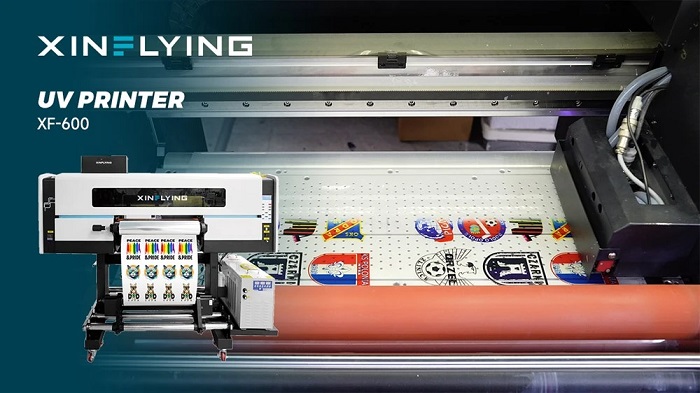
For promotional drinkware suppliers and contract decorators running hundreds of tumbler emblems and full-wrap graphics weekly, a 60 cm multi-head roll-to-roll machine keeps gang-sheet throughput high while delivering smooth, scratch-resistant clear varnish over every decal. Operations managers evaluating 60 cm industrial systems such as the XINFLYING XF-600—or comparing four-head models like the XF-600S and XF-600st—can review the complete specifications across XINFLYING roll-to-roll UV DTF printer machines to match roll width and varnish channel capacity to their order volume.
By pairing a 60 cm inline-laminating platform like the XINFLYING XF-600 with powder-coat texture testing, thorough IPA degreasing, and clear hand-wash care cards, print shops can build a reliable, high-margin custom drinkware business without rotary fixture headaches.